Dai Vernon's Revelations 30th Anniversary Deluxe Edition
Dai Vernon · 2012
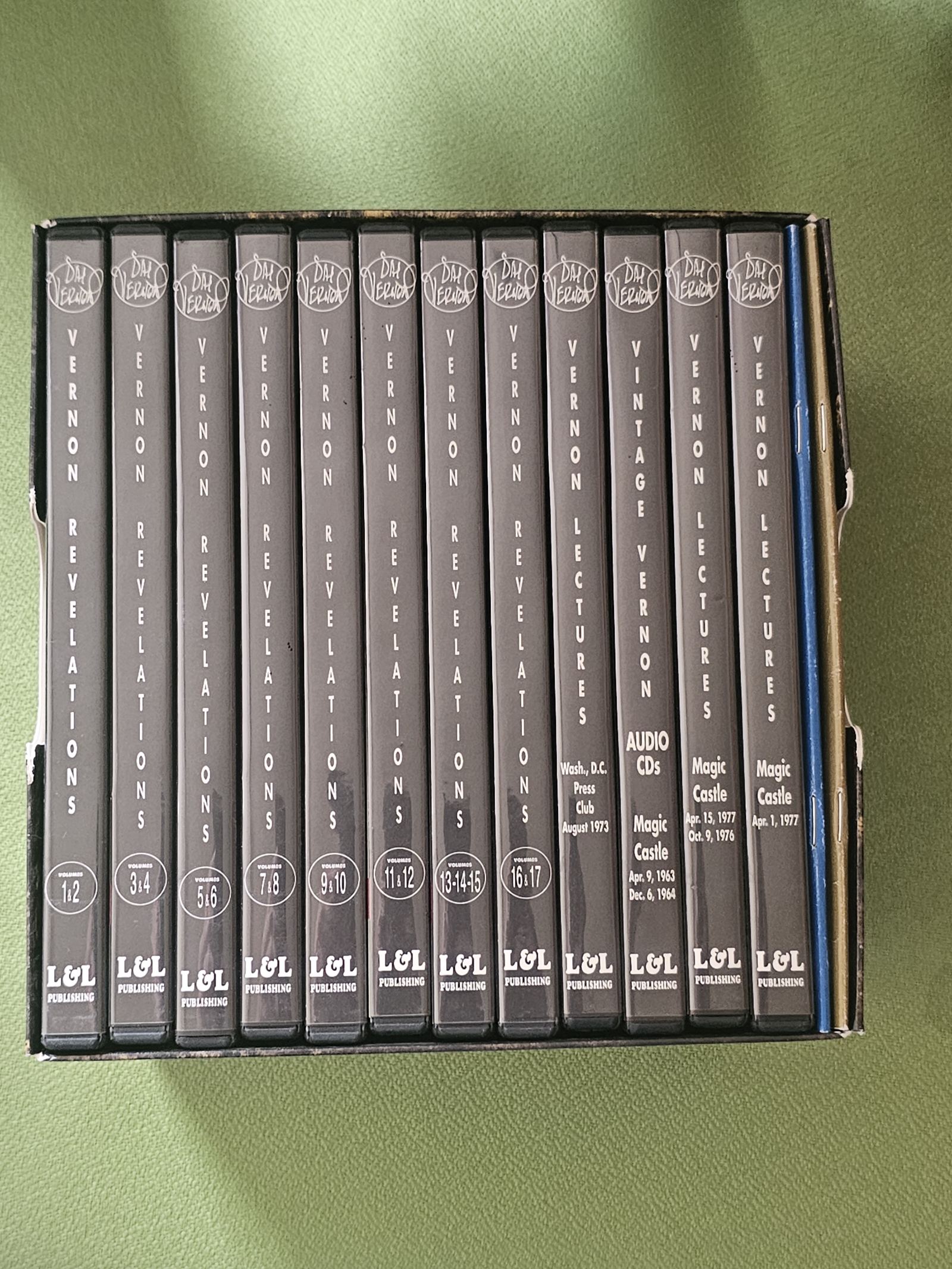
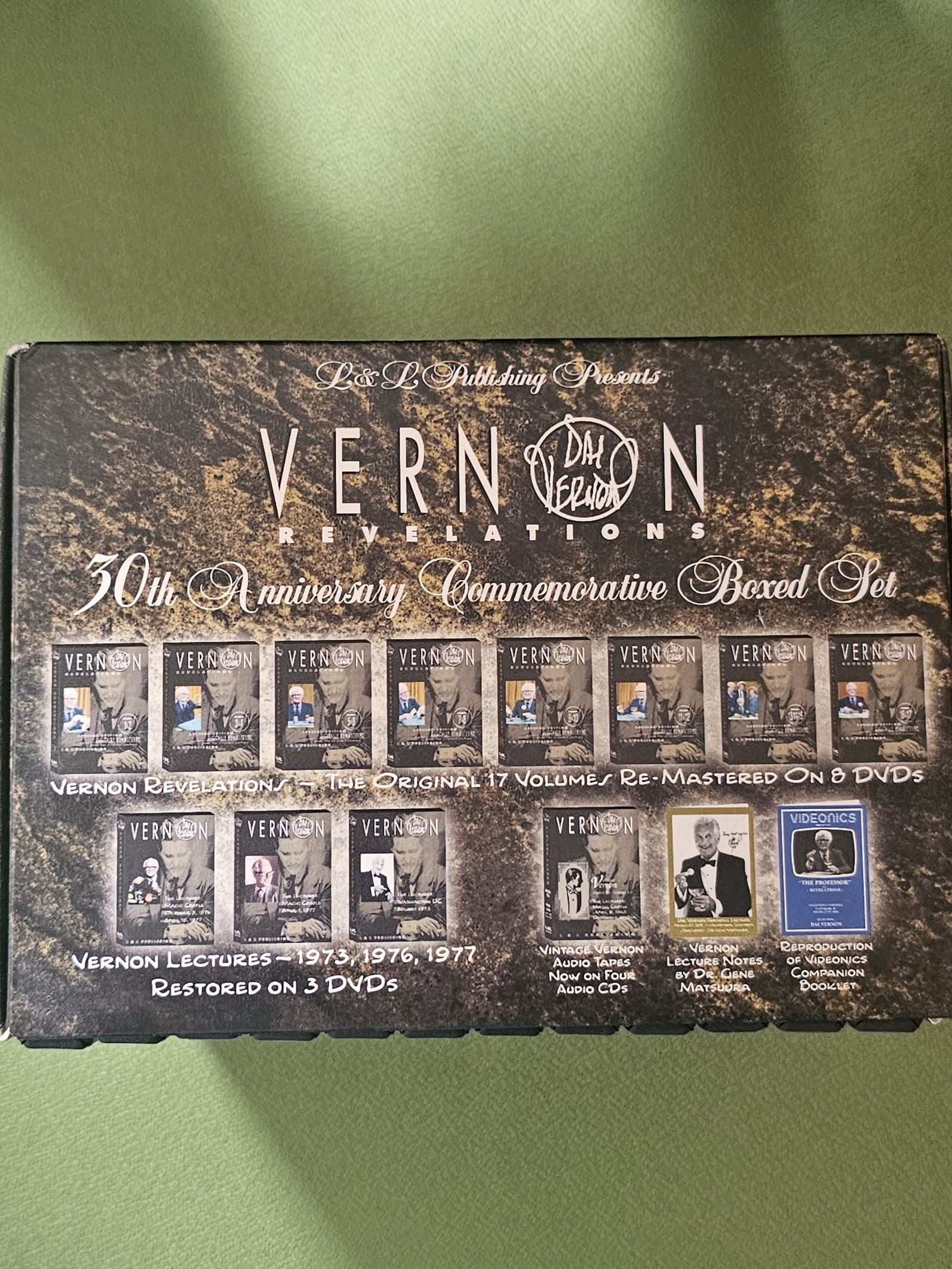
A comprehensive eleven-DVD, four-CD and two-booklet archive of Dai Vernon's teaching, rare lectures, technique, theory and magic history.
A landmark record of Dai Vernon’s thinking
Dai Vernon’s Revelations 30th Anniversary Deluxe Edition is far more than a conventional instructional DVD collection. It preserves the voice, methods, memories and working philosophy of the magician known throughout the magic world as “The Professor.” The original Revelations sessions were recorded from 2 to 6 September 1982 in St. John’s, Newfoundland, when Vernon was eighty-eight. Michael Ammar, Gary Ouellet and Steve Freeman joined him as hosts, demonstrators and informed conversation partners. Their presence matters: Vernon could concentrate on details, history and judgment while younger, technically accomplished magicians clarified actions and performed material when necessary. The result feels less like a scripted course and more like a privileged seat at an extended private session.
What the anniversary box contains
The edition was issued in 2012, thirty years after the filming. It gathers all seventeen original Revelations volumes, digitally remastered and arranged across eight DVDs. Three additional DVDs contain nearly six hours of rare lecture footage from the 1970s. Four audio CDs preserve lectures from 1963 and 1964. Two printed booklets add context: a facsimile of the original Videonics catalogue, with extensive commentary by Sid Lorraine, and Dr. Gene Matsuura’s notes from Vernon’s 1976 farewell lecture. The discs and printed material were supplied in a full-colour slipcase. A complete second-hand copy should therefore be checked carefully: eleven DVDs, four audio CDs, two booklets and the outer packaging are all relevant to completeness and value.
The historical recordings
The central eight DVDs document one of the most ambitious attempts to preserve the knowledge of a twentieth-century master magician. Videonics producer Hans Zahn undertook the original project after encouragement from Bill Larsen. Vernon was not simply asked to perform a succession of polished tricks. Instead, the group discussed effects, techniques, sources, refinements and the reasoning behind apparently small choices. Roughly half the subjects had appeared in print before the filming, while much of the remaining material was new at the time. Even familiar Vernon classics receive corrections and additional touches. For students who know routines only from books, the opportunity to hear Vernon describe timing, naturalness, construction and audience management can change how the written explanations are understood.
Card magic at the centre
Playing cards occupy a large part of Revelations. The discussions include Triumph, twisting and turning plots, multiple card controls, palms, passes, double lifts, colour changes, false deals, false shuffles, cuts, forces and methods associated with The Expert at the Card Table. Vernon spent decades studying Erdnase, and the recordings show both his fascination with the book and his refusal to accept technique without purpose. The viewer repeatedly encounters the idea that a move should look like an ordinary action and should serve a clear magical effect. Steve Freeman’s demonstrations are especially valuable in technically demanding Erdnase material. Ammar and Ouellet help turn Vernon’s sometimes conversational explanations into visible, repeatable actions without reducing the sessions to mechanical tuition.
More than card technique
The set is often described as card magic, but its range is considerably wider. Vernon discusses coins, the Cups and Balls, Linking Rings, rope magic, colour-changing silk, the walnut trick and other classic subjects. Material such as Five Coins and a Glass and thoughts related to the Ramsay Cylinder and Coins reveal his interest in economy, rhythm and convincing handling. The non-card sections prevent the collection from becoming a catalogue of sleights. They show that Vernon’s principles were transferable: remove unnecessary movement, understand where attention rests, make secret actions resemble innocent ones and develop a routine until every phase has a reason. Those lessons are useful to close-up performers, parlour magicians and serious students of theatrical deception.
How Vernon teaches
This is not a modern course with short chapters, animated labels and a presenter reading a fixed script. Vernon digresses, remembers performers, challenges assumptions and returns to ideas from another direction. That structure demands patience, but it is also the source of the collection’s unusual value. Viewers hear how an experienced magician evaluates a trick rather than merely seeing the final method. His anecdotes place techniques inside a living tradition and identify the people from whom ideas came. The hosts occasionally prompt him, question details or demonstrate an interpretation. A student who watches with a notebook will find practical instruction, historical information and standards for judging magic. The set rewards repeated viewing because an apparently casual sentence can become important only after the viewer has practised the routine being discussed.
The three bonus DVD programmes
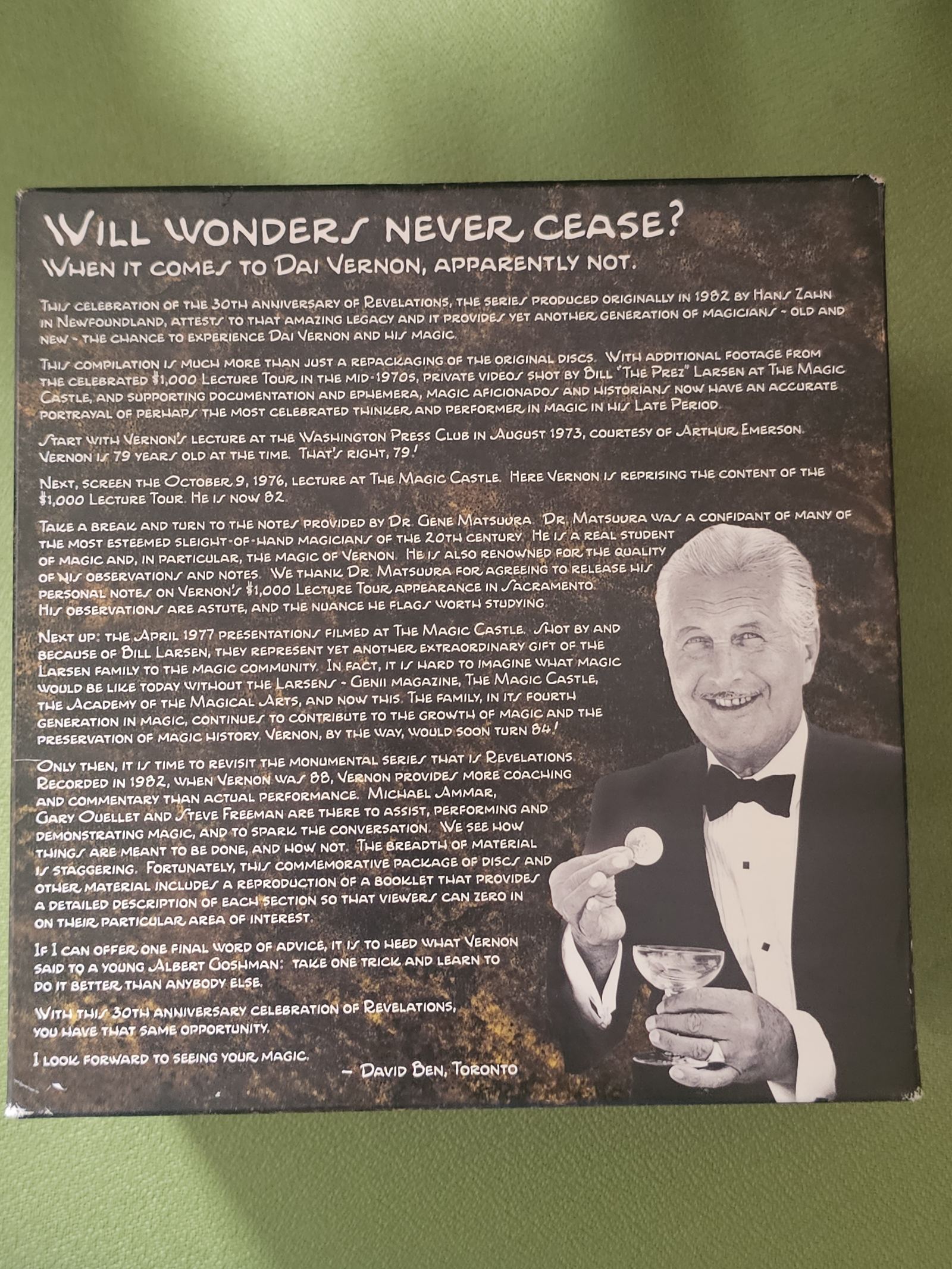
The bonus footage broadens the portrait of Vernon before the 1982 sessions. It includes a Washington Press Club lecture from August 1973, a Magic Castle lecture from 9 October 1976 and presentations filmed at the Magic Castle in April 1977. Picture quality reflects the age and circumstances of the recordings; these are archival documents rather than contemporary studio productions. Their importance lies in seeing Vernon address magicians in different settings and at different points in his later career. The footage includes general magic, card work and recurring subjects that Vernon considered important enough to revisit. Repetition across the lectures is useful: it reveals which ideas formed the durable core of his teaching and how his explanations changed with audience and occasion.
The four audio lectures
The audio CDs preserve lectures from 9 April 1963 and 6 December 1964. Audio requires concentrated listening, yet it also encourages the student to focus on language, structure and emphasis instead of watching only the hands. These recordings extend the historical span of the collection and let the listener compare Vernon in the 1960s with the filmed lecturer of the 1970s and the conversational teacher of 1982. Some themes naturally recur. Rather than being pointless duplication, those returns show how consistently Vernon valued simplicity, natural action and intelligent construction. For collectors, the CDs are also reminders of an era when lecture recordings circulated privately among dedicated magicians and access to a master’s voice was rare.
The printed booklets
The two booklets make the box easier to study and more significant as an archive. The facsimile of the 1983 Videonics catalogue provides descriptions and period context, while Sid Lorraine’s commentary helps the reader navigate the extensive filmed material. Gene Matsuura’s notes record close observations from Vernon’s celebrated 1976 lecture tour. Notes made by an attentive specialist can capture small points that a camera misses or that a speaker assumes his audience already understands. David Ben’s introductory essay presents the added footage and documents as a portrait of Vernon’s late period, not merely as bonus material attached to a reissue. Buyers of used copies should verify that both booklets are present and inspect them for annotations, missing pages or moisture damage.
Published customer and reviewer opinions
Public reactions are strongly positive, while also identifying sensible reservations. Penguin Magic displays an average rating of 4.8 out of 5 from four reviews. Reviewers praise the breadth of the tuition, Vernon’s advice and the assistance of the co-hosts; one buyer regarded the set as unusually good value and close to essential for a serious student. The customer review on Vanishing Inc likewise presents it as a masterclass and recommends obtaining it when available. These are individual opinions, not guarantees that every viewer will use every item. Their common theme is that the collection’s value comes from sustained access to Vernon’s thought, rather than from a promise of instantly performable tricks.
An independent professional assessment
W. S. Duncan reviewed the anniversary edition in the April 2012 issue of M-U-M Magazine. He highlighted the extraordinary opportunity to revisit filmed and recorded lectures by a major historical figure. His review considered the price in relation to the three bonus DVDs, four audio CDs and the complete original series, and concluded that the quantity of valuable thinking could benefit almost any magician. Duncan also reported a criticism from owners of earlier editions: buying the anniversary box meant purchasing the original Revelations material again because the new archival programmes were not offered separately. That concern is fair and remains relevant in the second-hand market. For a buyer without the earlier set, duplication is not an issue; for an existing owner, the decision depends on the value placed on the new lectures, CDs, booklets and packaging.
Strengths of the edition
Its greatest strength is depth. The box offers technique, routines, theory, history, personality and primary-source documentation in one coherent collection. The interaction with Ammar, Ouellet and Freeman gives the sessions clarity without erasing Vernon’s voice. The time span from the 1960s to 1982 allows students to observe ideas across decades. The physical extras make the edition more useful for research than a bare set of video files. It is also unusually broad: a card specialist can study advanced handling and Erdnase, while a general magician can explore coins, classics and performance principles. A viewer prepared to pause, take notes and practise will continue discovering details long after the first viewing.
Limitations and expectations
Prospective buyers should understand the format before purchasing. Much of the video was recorded decades before high-definition teaching became standard. Some bonus footage looks and sounds archival. Vernon was in his later years, and the 1982 material often emphasizes explanation, recollection and commentary rather than continuous polished performance. The conversational pace will feel slow to viewers seeking quick tutorials. The sheer amount of content can also be overwhelming, and not every technique is suitable for every skill level. These are not defects hidden by the edition; they define what it is. Revelations works best as a library and long-term course of study, not as an evening’s entertainment or a shortcut to professional technique.
Who will benefit most
The ideal owner is a magician interested in foundations, construction and the history behind methods. Intermediate and advanced card workers will find the technical discussions immediately relevant, but ambitious beginners can also benefit if they study selectively and use simpler sections first. Teachers, collectors, magic historians and club libraries gain value from the documentary material. Performers who work mainly with coins or classic apparatus should not dismiss the set, because Vernon’s advice about attention, naturalness and economy applies beyond cards. Someone who wants only a few self-working effects may find a smaller modern download more convenient. Someone who wants to understand why influential magicians think as they do will find few video collections with comparable scope.
A practical way to study it
Trying to watch every disc in rapid succession is unlikely to produce the best results. Begin with one subject that already matters to your repertoire, such as Triumph, a false shuffle or Cups and Balls. Watch the relevant discussion once without interruption, then watch again with cards or props in hand. Write down not only the mechanics but also Vernon’s comments about effect, motivation and timing. Compare the co-host’s demonstration with your own natural handling. Practise for several days before returning to the section. Later, view one of the earlier lectures and note where the same principle appears. This method turns the large collection into a sequence of manageable studies and makes repeated material an advantage.
Collecting and condition
Because the edition may be discontinued, condition and completeness can influence second-hand prices. Confirm the presence of all discs and printed items, and ask whether the DVDs and CDs have been tested. Surface marks do not always prevent playback, but scratches, disc rot or damaged hubs deserve attention. Examine photographs of the slipcase, individual cases and booklets rather than relying only on a stock image. Regional playback compatibility may matter on older equipment, so buyers should check the specific copy and their player. The box is valuable primarily for its content, yet collectors may pay more for clean packaging and unmarked booklets. A seller should describe missing pieces or playback problems clearly.
Place in a magic library
Revelations belongs beside major books by and about Vernon rather than in a pile of disposable trick downloads. It does not replace written sources, and the books often provide tighter descriptions for detailed practice. The recordings add voice, gesture, emphasis and spontaneous judgment that print cannot preserve. Used together, video and text show how a method develops from technical description into a deceptive performance. The set also documents relationships among generations of magicians: Vernon recalls earlier masters while Ammar, Ouellet and Freeman help transmit his work to later students. That chain of teaching is one reason the anniversary edition remains culturally important even when individual techniques can now be found elsewhere.
Overall assessment
Dai Vernon’s Revelations 30th Anniversary Deluxe Edition is a substantial historical and instructional archive. Its eleven DVDs, four audio CDs and two booklets demand time, but they repay careful study with methods, refinements, stories and principles accumulated over a lifetime. Published buyers and reviewers largely agree on its exceptional educational value, while the duplication issue and archival production quality deserve honest mention. For a magician who does not own the earlier Revelations series, a complete copy offers an unusually concentrated route into Vernon’s work. For an existing owner, the decision rests on the rare lectures and documentation. Either way, the edition is best understood as a reference collection to revisit for years, not simply as another box of tricks.