You, Too, Can Read Minds
George B. Anderson · 1968
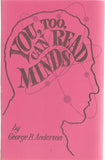
George B. Anderson’s 1968 sequel expands his practical mentalism with predictions, book tests, psychometry, drawing duplication, muscle reading and blindfold work.
A practical sequel for working mentalists
Published by Magic, Inc. in Chicago in 1968, *You, Too, Can Read Minds* continues the practical approach George B. Anderson established in *It Must Be Mind Reading*. The original edition is a compact, stapled booklet of about 63 pages, but its contents range widely. Anderson writes for performers who want direct mental effects that can be understood by a real audience, staged without elaborate scenery and adapted to clubs, parlours or small theatres.
What the book contains
The table of contents shows how varied the programme is. Number revelations and predictions appear beside a bystander book test, word divination, drawing duplication, billet-style message reading, psychometry and muscle reading. Titles such as “Here’s Your Number,” “Impossible Mind Reading,” “Bystander Book Test,” “Find the Killer,” “Duplicating a Drawing,” “Flash Prediction” and “Ultimate Dollar Bill Divination” point to effects with clear plots rather than abstract technique. Anderson also discusses a blindfold associated with Harry Blackstone. Readers should treat that section as historical performance material and apply modern safety standards before attempting any blindfold work.
The strongest feature is not a single secret but Anderson’s economy. Many routines use familiar objects and place the dramatic emphasis on the participant’s thought. His instructions encourage the performer to make the effect easy to follow: establish what information is unknown, keep the procedure short, and give the revelation a definite finish. That makes the book useful even when a reader chooses to replace dated props or wording.
How to study it today
This is mid-century mentalism, so it should not be copied word for word. Some language, assumptions and claims about mind reading belong to their period. A modern performer can preserve the structure while writing a personal script, stating the entertainment context clearly and protecting volunteers from embarrassment. The psychometry and “killer” premises in particular benefit from careful framing. Drawing duplication and book-test material can be updated with objects that look natural in the performer’s present environment.
A useful study method is to select one routine, describe in one sentence what the audience should remember, and then rehearse only the actions that support that memory. Test the instructions aloud, note where a participant might misunderstand, and prepare an alternate ending for imperfect information. Anderson’s concise construction becomes most valuable when the reader does this practical work rather than merely collecting methods.
Edition and collector notes
Early copies are usually described as blue illustrated stapled wraps, published by Magic, Inc. in 1968. Later printings also circulate, so buyers should compare the title page, publisher information, pagination and cover rather than relying on the title alone. Check staples for rust, the spine fold for splitting, and the pages for annotations or missing leaves. Notes from a working performer may be interesting, but they should be disclosed by the seller.
For collectors, the book documents the post-war American mentalism tradition and Anderson’s preference for usable material. For performers, it remains a compact source of adaptable plots. Its value lies in the combination of variety, clarity and the practical question behind every chapter: what will the audience believe it has just witnessed?