Mind, Myth, and Magick
T. A. Waters · 1993
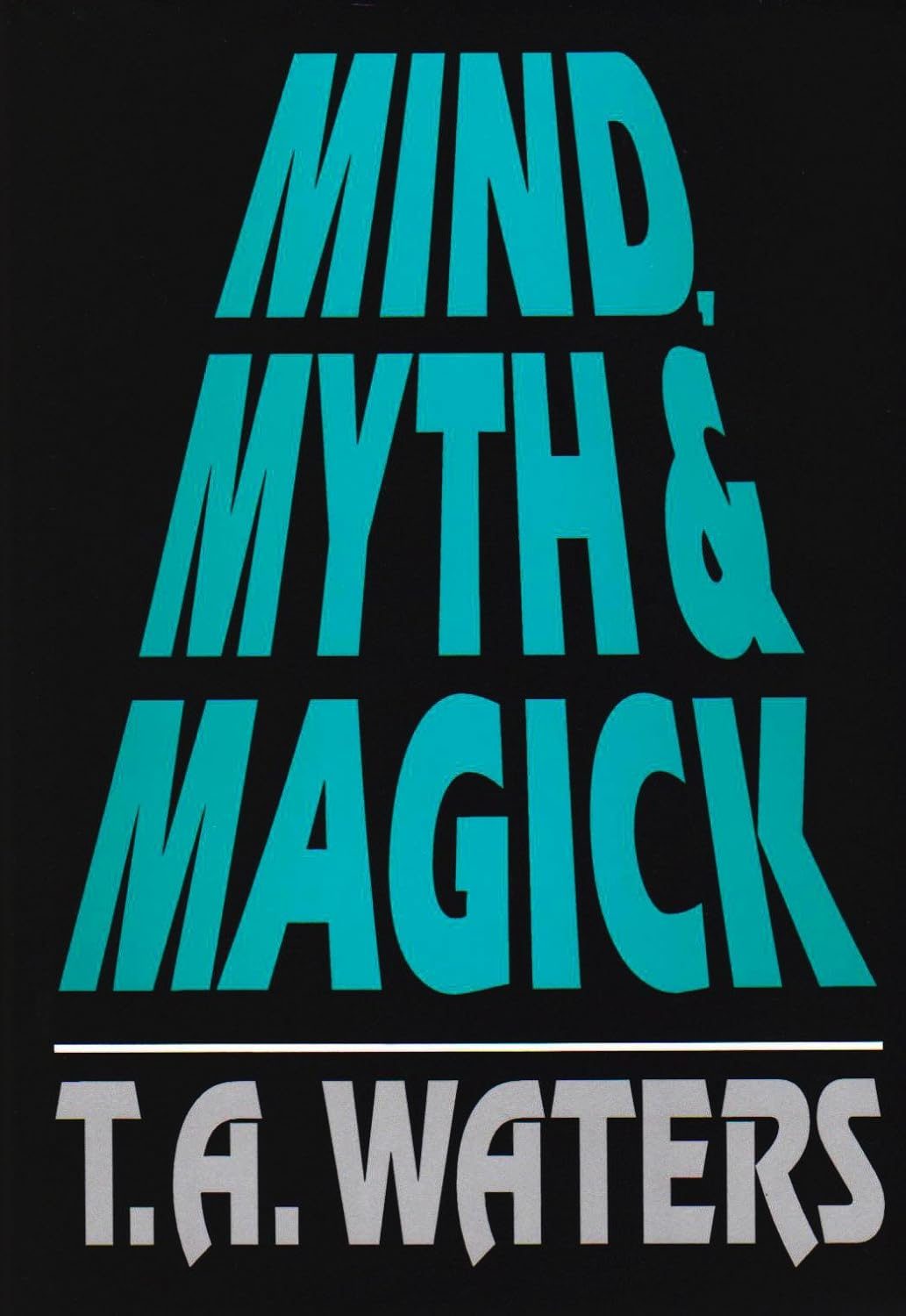
A detailed guide to T. A. Waters’ landmark collection of more than 200 mentalism and bizarre-magick routines, essays and working principles.
A major reference work in modern mentalism
Mind, Myth, and Magick is T. A. Waters’ largest and most influential collection. Hermetic Press issued the hardcover in 1993, bringing together twenty-one specialist booklets that Waters had released between 1979 and 1987. The material was revised, expanded and newly illustrated by Kelly Lyles. Depending on the printing, bibliographic listings describe the volume as roughly 805 to 828 pages. The original edition carries ISBN 0-945296-10-X / 978-0-945296-10-2.
This is not a beginner’s course arranged from easy fundamentals to advanced technique. It is closer to a working library by one unusually inventive author. More than 200 routines, methods, variations and essays range across mind reading, prediction, psychometry, book tests, billet work, symbol tests, tarot, fortune-telling, spirit-themed demonstrations, card mentalism and bizarre magick. Its scale explains why performers often treat it as a book to revisit rather than read once from cover to cover.
How the book is organised
The volume preserves the identities of Waters’ earlier publications. Sections include New Thoughts for Old, Cerberus, Trionic, Omnimancy, Psychometry, Scrypt, Deckalogue, Grymwyr, Octasm, the three Mindscript volumes, Psychl, Cardiact, Mynd, Spyryt, Thynk, Myxtyr, Mystyx, Fynys and T.A.R.O.T. Cross-references help connect methods and themes that recur in different chapters.
This structure has advantages and limitations. Each booklet has its own voice and area of interest, so a reader can study one branch without digesting the entire volume. At the same time, the book is not a single linear curriculum. Some ideas assume familiarity with traditional mentalism terminology, common props and older literature. The index and cross-references are therefore important working tools.
What makes Waters distinctive
Waters was interested in systems rather than isolated secrets. Many entries begin with a familiar premise and then question its weak points: what the audience is meant to believe, which choices appear free, when information is obtained, how a revelation is framed and what practical failure points must be controlled. The result is often more useful than a bare description of method.
His taste also extends beyond conventional prediction effects. He explores theatrical atmosphere, symbolic objects, divination systems and story-led presentations. That makes the collection especially relevant to mentalists who want material with a stronger identity than a sequence of unrelated puzzles. The bizarre-magick material reflects its period, but its central lesson remains current: method, premise and character should support one another.
Practical value for performers
The book contains material for close-up work, informal demonstrations, platform performance and full routines. Not every item will suit every performer, and that is part of the book’s value. A working reader can compare several approaches to psychometry, book tests or predictions and identify the trade-offs between preparation, handling, clarity and impact.
Because the descriptions are method-rich, responsible rehearsal is essential. Some routines need custom props, careful scripting or confident audience management. Others use ordinary objects and can inspire practical adaptations. The strongest way to study the book is to choose one subject, read the related chapter and cross-references, then test a single routine before moving on.
Who should buy it
Mind, Myth, and Magick is best suited to intermediate and advanced mentalists, collectors of important conjuring literature, and experienced magicians building a serious mentalism repertoire. A newcomer can learn a great deal, but may benefit from first understanding standard concepts such as billets, forces, outs, multiple realities and audience management.
Buyers should also distinguish between printings and languages. The 1993 Hermetic Press hardcover is the edition most often cited by collectors, while later reprints may differ in pagination, binding and jacket. French editions were divided into volumes. When comparing used copies, check the publisher, ISBN, printing statement, presence and condition of the dust jacket, binding, annotations and completeness.
Collector and condition notes
Large working books often show wear. A sound binding matters more than minor rubbing because the heavy text block can strain the hinges. Inspect the spine, both hinges, page block, moisture marks, highlighting, owner inscriptions and any loose pages. A clean dust jacket improves collector appeal, but a well-used copy can still be an excellent practical purchase if the binding and contents are complete.
Mind, Myth, and Magick earned its reputation through breadth, imagination and the density of usable thinking it contains. It rewards selective, repeated study and remains a substantial record of Waters’ approach to mentalism.