The Mental Mysteries and Other Writings of William W. Larsen, Sr.
William Larsen Sr. · 1977
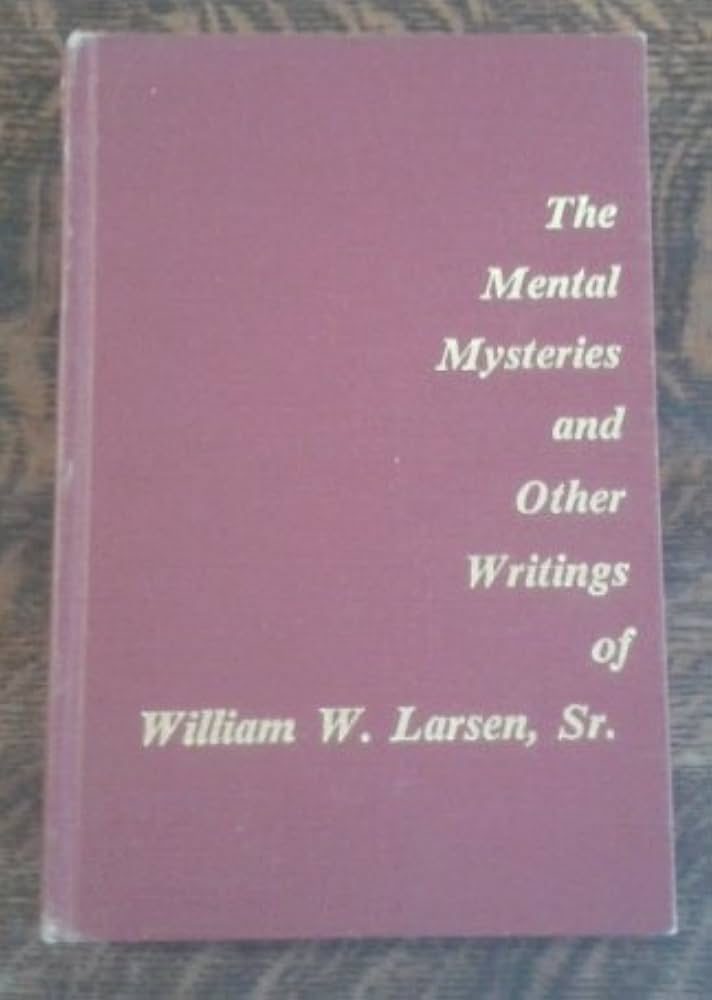
A substantial anthology of William W. Larsen Sr.’s professional mentalism: readings, muscle reading, coded telepathy, publicity lectures, séances, escapes and the influential Dr. Q material.
A major Larsen anthology
The Mental Mysteries and Other Writings of William W. Larsen, Sr. was issued by Genii Publishing in 1977, more than two decades after Larsen’s death. The hardcover gathers manuscripts, lectures and performance material written across his career. It is sometimes shortened in listings to The Mental Magic of William Larsen Sr., but collectors should use the full title when identifying the book. The first edition is commonly described as a maroon cloth volume with gilt lettering and illustrations.
This is not a single-course introduction to mentalism. It is an archive of working material by a performer who was also a lawyer, editor and magic publisher. Its chapters move between methods, complete acts, publicity pieces, legal commentary and historical curiosities. That range makes the volume unusually revealing about the professional world in which pre- and post-war mentalists worked.
William W. Larsen Sr.
William W. Larsen Sr. lived from 1904 to 1953. He practised law in California, performed magic and mentalism, owned the Thayer Studio of Magic for part of the 1940s and founded Genii magazine in 1936 with his wife Geraldine. His sons William Jr. and Milt later continued the family’s influence through Genii, the Academy of Magical Arts and the Magic Castle.
Larsen wrote under his own name and as Dr. Frederick Straussborg. Many texts in this collection had previously circulated as separate professional manuscripts. The 1977 compilation therefore preserves material that would otherwise have remained scattered and difficult to locate.
What the book contains
The contents open with The Pineal Eye and The Resort Hotel Psychic Business, then move through a lecture for Annemann’s Pseudo Psychometry, Tarot Telepathy and Contact and Non-Contact Mindreading. Further chapters discuss fortune telling, Larsen’s Evidence of Deception lecture, the People v. Miracles Smith court case, complete card readings, J. Thurman Lord material, life-span reading and message-bearing tests.
The later half broadens into a witch-doctor test, spook-show routines, the Final Houdini Séance, handcuff and box escapes, a lecture on Houdini, palm reading and a large group of Dr. Q items. These include Living or Dead, the Hypnotic Act, Gyrating Tables, Number Please, Simplicity Mindreading and Sight Unseen. The variety is one reason the book is better treated as a historical working library than as a linear textbook.
Muscle reading and contact mindreading
The chapter on contact and non-contact mindreading is one of the volume’s best-known sections. The technique, often called muscle reading or Hellstromism, uses minute involuntary responses to guide the performer toward a hidden object or chosen location. Dai Vernon reportedly praised Larsen’s explanation as one of the finest in print.
Its practical value lies in the emphasis on confidence, movement and communication rather than a mechanical secret. Success depends on recognising pressure and changes in direction while maintaining a clear dramatic objective. Readers should practise only with informed partners, avoid forceful handling and treat the demonstration as a learned performance skill rather than paranormal proof.
Readings, telepathy and coded information
Tarot Telepathy and the card-reading chapters show how structure, stock interpretation and discreet information can create a coherent personal reading. Tarot Telepathy includes verbal coding that can communicate characteristics of a participant to a blindfolded reader. The method is historically important because it shows how a convincing two-person act may be built from economical signals and rehearsed interpretive material.
Modern performers must separate theatrical value from outdated claims. Readings can affect decisions about health, grief, money and relationships. They should be framed as entertainment or reflection, never as a substitute for qualified advice. Larsen’s legal discussions are valuable documents of their time, but they are not current legal guidance.
The Dr. Q material
The Dr. Q chapters are central to the book’s reputation. They preserve a commercial style of mental entertainment designed for clubs, hotels and public programmes. Sight Unseen and Simplicity Mindreading illustrate direct audience-facing mysteries; the Living or Dead Quiz uses a powerful emotional premise; the table and number routines show the breadth of the persona.
The Hypnotic Act requires special caution. Historical stage-hypnosis instructions may include physical procedures and assumptions that do not meet modern safety standards. They should be studied as history, not copied without contemporary professional training, screening, consent and medical awareness. The chapter’s presence increases the book’s documentary value while also demonstrating why old technical literature needs critical reading.
Evidence of Deception and public presentation
Evidence of Deception is especially interesting because Larsen reportedly delivered the illustrated lecture nearly two hundred times. It combines discussion with demonstrations and was suitable for legal, civic and political organisations. The piece reflects his dual identity as attorney and magician: deception becomes both entertainment and a subject for analysis.
This chapter can teach modern performers how to build a themed programme rather than string together unrelated tricks. A clear argument, varied demonstrations and a conclusion give the audience a reason to remember the whole event. The exact examples may date, but the programming principle remains strong.
Historical limits and responsible study
Some language, cultural assumptions and participant management belong firmly to the early and mid-twentieth century. The book should not be treated as scientific psychology. Claims about physiognomy, suggestion or psychic ability require sceptical evaluation, and routines using spiritualism, death or private concerns demand care.
A productive reader marks what is method, what is script, what is historical opinion and what is independently verifiable. That approach preserves Larsen’s technical ingenuity without importing every claim into a modern performance.
Collecting and edition identification
The 1977 Genii Publishing edition is the key reference point. Auction catalogues describe copies bound in maroon cloth with gold stamping, usually illustrated and in octavo format. Some copies carry inscriptions by William Larsen Jr. or association provenance, which can materially affect value. Condition matters: check the hinges, gilt, page block, illustrations, annotations, odour and evidence of moisture.
A seller should photograph the actual front and rear boards, spine, title page, copyright information and any signatures. The similar shortened titles used by dealers can cause confusion, so compare the title page rather than relying on a listing headline. A reading copy with honest wear may be preferable for study; a signed or association copy deserves archival handling.
Overall assessment
The Mental Mysteries and Other Writings is important because it preserves a professional repertoire and the thinking around it. Muscle reading, two-person coding, card and palm readings, séance theatre, publicity lectures, escapes and the Dr. Q material reveal mentalism as a complete performance business rather than a collection of isolated secrets.
Its strongest lessons concern construction, authority, rehearsal and the creation of a sustained atmosphere. Its weakest or riskiest passages remind the reader that historical methods must be tested against modern ethics and safety. For mentalists, historians and serious collectors, it is a rich primary source whose value increases when studied critically rather than copied literally.