The Encyclopedia of Card Tricks
Jean Hugard · 1937
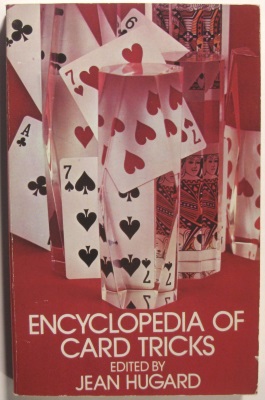
Jean Hugard’s extensive reference collection of card magic: ordinary cards, prepared packs, spelling effects and contrasting methods, with guidance on editions and buying a used copy.
A reference library in a single volume
The Encyclopedia of Card Tricks is a collection to consult, explore and return to when a particular card problem catches your interest. Edited by Jean Hugard, it brings together a broad range of approaches rather than teaching one continuous sequence of increasingly difficult lessons. Its appeal lies in that variety: a reader can compare effects that rely on different conditions and decide which ones suit a particular performance.
The work first appeared in 1937. Dover’s later edition is a corrected, unabridged republication, not a newly written modern course. That distinction helps explain both its usefulness and its limitations. This is an opportunity to examine established card magic in written form, with the reader responsible for turning instructions into a convincing performance.
What makes the collection distinctive
The chapter arrangement includes impromptu tricks, spelling effects, “You Do As I Do,” key cards and prepared packs. It also distinguishes several kinds of special cards and decks. These are practical distinctions, because two effects that look similar to an audience can require very different preparation, handling and opportunities for examination.
A useful way to approach such a collection is to start with the circumstances in which you actually perform. Do you usually have your own pack? Can you set anything beforehand? Must spectators shuffle? Will you be standing, or working at a table? Those questions give the contents a purpose. Instead of collecting every possible trick, you can identify material compatible with your working conditions.
The breadth also prevents a misleading expectation: this is not exclusively a book of tricks with borrowed, freely shuffled cards. Nor does inclusion in a reference collection mean that every item has the same difficulty. Read an explanation completely before deciding that an effect belongs in your repertoire.
Ordinary cards and prepared material
The difference between an ordinary deck and a prepared one matters most when deciding how an effect fits into a larger sequence. With an ordinary pack, the performer may have more freedom to move between routines. With special material, an apparently simple effect may need a separate introduction, a controlled handling sequence or an appropriate conclusion.
That is not a judgment against prepared cards. It is a reminder to evaluate the whole performance rather than the climax alone. Consider what the audience sees before the trick begins, what happens if somebody asks to handle the cards, and how you continue afterwards. A strong choice is one whose conditions you can manage naturally, without making the equipment itself the centre of attention.
For a second-hand purchase, remember that the book supplies explanations. It should not be assumed to include the decks, duplicate cards or other materials required by particular entries. Any accompanying accessories must be stated separately by the seller.
Spelling effects and the problem of language
Spelling-based card magic deserves particular attention from readers performing outside English. Translating the spoken presentation does not necessarily preserve the operation of a trick. Card names, expressions and the number of letters can change between languages. Even a familiar suit may require a different count.
Before presenting such an effect in German, French, Italian or Spanish, work through the exact words you will use. Check the written procedure against those words and test the result with every relevant selection. A successful trial with one convenient card is not sufficient evidence that the translated version works generally.
This gives the book a productive role as a source of ideas rather than a script to repeat unchanged. You may find a structure worth adapting, but any adaptation needs its own verification. Keep the original and revised handling in separate notes so that they do not become confused during rehearsal.
Reading it as working material
Older written instructions demand a different kind of attention from a demonstration video. You must distinguish the visible effect from the actions that make it possible, and then determine how those actions will appear to a spectator. Reading with cards in hand is usually more useful than trying to absorb an entire chapter at once.
For a first session, choose one entry, reproduce its stated conditions and establish that you understand the procedure. Only then add speech, eye contact and audience participation. If something fails, return to the starting conditions before assuming the explanation is wrong. Small changes in order, counting or orientation can alter the outcome.
Avoid turning the book into a checklist of tricks performed once. A smaller selection, rehearsed thoroughly and presented clearly, will normally provide more practical value than superficial familiarity with many entries. Record what preparation each selection needs and whether it can follow the routine before it.
Who is likely to use it well?
The strongest reason to choose this title is a desire for a wide reference collection. It can serve a reader who already enjoys card magic and wants to investigate alternatives, revisit older ideas or find an effect that meets a particular restriction.
A complete beginner seeking a tightly guided programme may prefer to establish basic handling through a structured course first. The encyclopedia can then become a companion resource. Its size should not be mistaken for a promise that every question about technique, presentation or audience management will be answered in a beginner-friendly order.
For an experienced reader, the productive question is not simply “Is this old?” but “Which part of this idea is useful under my conditions?” An old premise may require a different presentation, while a method may still suit a contemporary performance. Make that assessment effect by effect.
Editions and buying a used copy
Bibliographic records do not give one universal page count. Dover records and library entries use different pagination, while a Foulsham edition is recorded at 448 pages. Ask for the actual publisher, publication date and edition of the offered copy instead of identifying it solely from the title or a stock cover.
The image shown here represents a Dover cover. It is an illustration of an edition, not proof that a particular seller’s copy has the same binding or cover design. Photographs of the item being sold remain the best way to judge condition.
Check that the book is complete, the binding holds securely and the diagrams remain legible. For a reference work opened repeatedly with cards in hand, loose pages and a damaged spine matter more than modest cosmetic wear. Clear photographs of the title page, contents and any defects help distinguish an attractive listing from a useful working copy.