Dynamite Mentalism
George B. Anderson · 1979
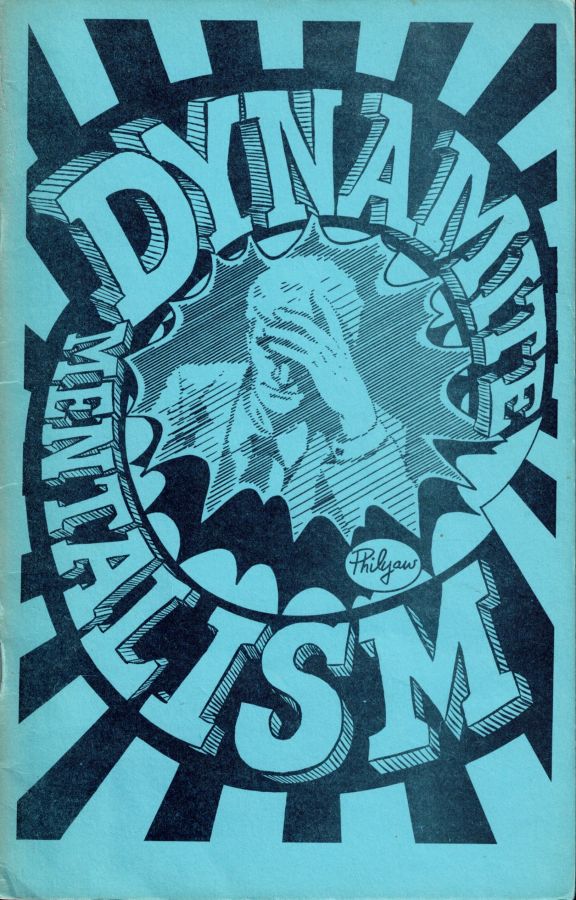
George B. Anderson’s focused booklet on a spoken Q&A act: thought-of questions, reading-style presentation and the demands of performing without written billets.
A compact study of the Q&A act
Dynamite Mentalism by George B. Anderson was published by Magic Inc. in 1979. It concentrates on a question-and-answer presentation rather than offering a large collection of unrelated tricks. The interesting distinction is that the spectator’s question need not be written down or spoken aloud. The apparent effect is a response to something held privately in mind.
This is therefore a different purchase from a book of predictions, card effects and apparatus demonstrations. Its subject is a sustained exchange between performer and audience. The booklet is relevant if you want to explore how an apparently personal answer can become theatrical material without relying on the familiar image of collecting written questions.
What the contents establish
The documented edition is a 28-page, stapled softcover. Its contents include opening remarks, age-group reading sections, alternate final questions, responses to objections and a memory aid. These headings describe a focused working structure, not a comprehensive education in every form of mentalism.
There is an important distinction between the length of the text and the work required to perform it. A short booklet can be quick to read while still demanding considerable rehearsal. Here the challenge is not simply remembering a sequence of physical actions. Delivery, selection of participants, clarity and the handling of responses affect whether the presentation holds an audience.
No written question does not mean no preparation
The publisher describes a presentation in which neither a written question nor a spoken disclosure is required from the spectator. That describes the intended effect; it should not be mistaken for a guarantee of effortless performance or literal access to another person’s thoughts.
For a prospective buyer, the practical question is whether this style suits your stage character. Someone who prefers an unmistakable visual result may find a verbal reading less comfortable. Someone who enjoys conversation and can keep an audience engaged through speech may find the premise more useful. The two preferences are different performance choices, not measures of quality.
The absence of bulky equipment also does not make every venue suitable. If people cannot hear the exchange, they cannot follow its significance. A quiet setting, clear amplification where needed and an audience willing to listen are worth considering before choosing this kind of material for an event.
Reading the historical categories today
The booklet’s age and gender divisions reflect its period. They should be approached as historical features of the text, not dependable descriptions of every modern participant. People of the same age can have very different circumstances, and an assumption that felt conventional decades ago can now sound awkward or irrelevant.
An adaptation should therefore begin with language and tone. Ask whether an expression sounds natural in your voice, whether a participant could misunderstand it, and whether it invites an uncomfortable public disclosure. Preserve a respectful entertainment setting rather than pressuring someone to explain a private problem in front of strangers.
This is an editorial recommendation for using an older reading presentation, not a claim that Anderson supplies a modern guide to all these issues. The distinction matters: a product description should explain what a reader needs to assess without attributing extra content to the author.
Rehearsal and translation
A useful first exercise is to practise the spoken transitions separately from the apparent revelation. Record a run-through and check whether the audience would understand who is being addressed and when one exchange has ended. A sequence that reads clearly on the page can become confusing if delivered too quickly.
Readers performing in another language should translate for natural speech rather than reproduce English sentence patterns. Rehearse the revised wording aloud. This kind of act depends on the listener following a conversational thread, so a stiff translation can undermine the presentation even when its dictionary meaning is correct.
The published structure includes ways to address objections. That does not remove the need to practise calm, courteous responses. Treat an unexpected answer as part of live performance, not an invitation to argue with the spectator. The participant’s comfort remains more important than forcing an exchange towards a predetermined reaction.
Who should consider this booklet?
It is a targeted choice for a reader interested in verbal Q&A and reading-style mentalism. It is less suitable as a first and only guide to the whole field, or for someone specifically seeking explanations of mechanical props and visual tricks.
Its value should be judged by that narrow purpose. Do not buy it expecting a long anthology merely because the title sounds dramatic. The modest format is part of what it is: a specialist booklet devoted to a particular approach.
Buying a used copy
Ask the seller for photographs of the actual cover, title page and binding. Check that the text is complete and that staples have not rusted through the paper. On a slim booklet, detached centre pages or missing leaves can remove a substantial part of the material.
The product image illustrates one physical cover and does not identify the condition or printing of every offered copy. Image source: MagicLibrary.org, Ryan Pilling’s community bibliography, which states a Creative Commons Attribution licence for its content. No image from Lybrary.com or a dealer has been used.
MagicLibrary.org: https://magiclibrary.org/title/dynamite-mentalism