Conjurers’ Psychological Secrets
S. H. Sharpe · 1988
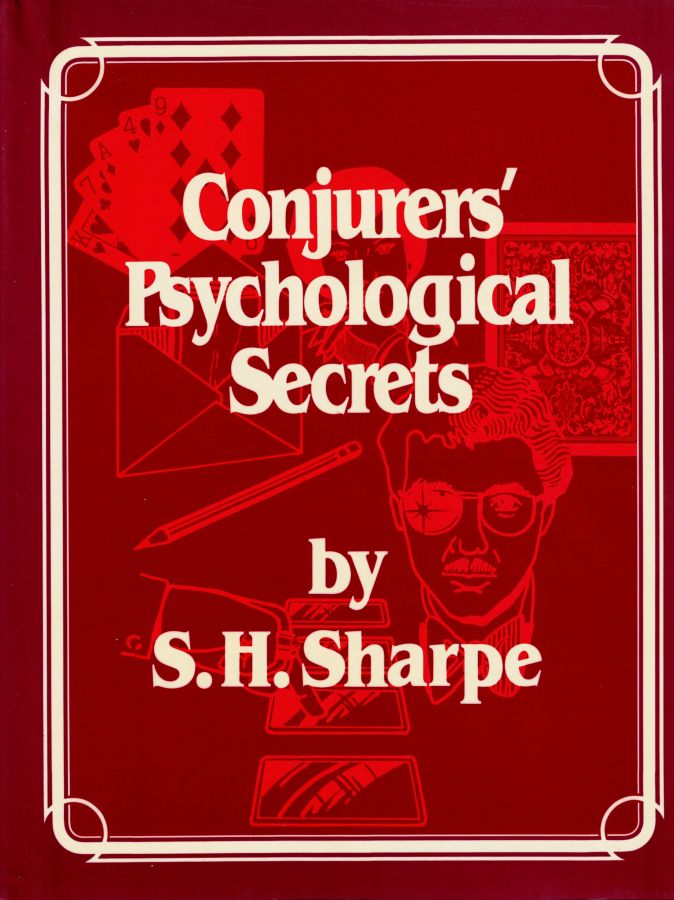
S. H. Sharpe’s 1988 taxonomy of perception, suggestion, misdirection, memory and reasoning in magic, presented as a practical design system for conjurers.
A map of the spectator’s mind
Conjurers’ Psychological Secrets is not a collection of tricks in the usual sense. S. H. Sharpe set out to classify the psychological conditions that allow conjuring to be experienced as impossible. Published by Micky Hades Publications in 1988, the large-format hardback belongs to Sharpe’s Secret Science series and examines perception, attention, suggestion, memory, imagination, reasoning and audience response.
The author behind the system
Sam H. Sharpe, commonly credited as S. H. Sharpe, was born in Retford, England, in 1902 and became one of conjuring’s most persistent historians and theorists. He wrote Neo-Magic, The Magic Play and a long sequence of studies devoted to optical, psychological, hydraulic, pneumatic and mechanical secrets. He also translated and edited important material by earlier European conjurers.
Publication and physical editions
The first edition appeared in 1988 as a hardcover from Micky Hades Publications in Canada. Bibliographic descriptions differ on pagination: some dealers and libraries record 178 numbered pages plus approximately fourteen pages of index or supplementary matter, while the William W. Larsen Memorial Library lists 192 pages. These figures can describe the same physical volume counted in different ways.
Four fundamental classes
Sharpe organises the subject around four broad classes: objective illusions, subjective illusions, influence by suggestion and intellectual processes. Within these he identifies more specific principles and supplies historical examples, practical observations, tables and memory aids. The categories are not meant as rigid boxes. They help a performer identify where an illusion is created: in sensory information, in internal experience, through suggestion, or through the spectator’s interpretation and reasoning.
Objective illusions and the senses
The opening class addresses visual, auditory and tactile experience as well as taste and smell. Optical principles are only one part of the discussion. Direction, duration, intensity and distance can be misjudged in sound; touch can be shaped through substitution, contrast and persistence. These observations encourage magicians to look beyond the hands.
Subjective illusions: time, condition and imagination
Sharpe’s second class examines illusions that arise within the observer. Mental time may feel shorter or longer than clock time. Age, expectation, subconscious impressions, associations and comparisons can alter judgement. An object may seem to have remained under a condition that was never clearly established, or a spectator may fill a gap with the most plausible story. These ideas are especially relevant to magic because audiences do not store a continuous recording.
Atmosphere, imagination and suggestion
Sections on creating atmosphere, inducing imaginary impressions and what Sharpe calls “putting on the ’fluence” consider the power of suggestion. Magic depends on prompting imagination: a box feels ominous because of how it is introduced, an ordinary choice feels consequential because of the story around it, and a pause may imply difficulty or danger. Atmosphere is not decoration added after the method.
Misdirection: active, passive, disguise and distraction
One of the book’s most influential sections is Sharpe’s classification of misdirection. He distinguishes active forms, involving a change in movement or sound, from passive forms that work unobtrusively through the spectator’s response to static conditions. He also separates disguise, which makes something appear uninteresting or different, from distraction, which introduces a stronger competing stimulus. This vocabulary prevents the common mistake of treating misdirection as “making people look away.”
Memory, clarity and the construction of impossibility
Sharpe repeatedly returns to clarity. Before a transformation can astonish, spectators must know exactly what existed before and what exists afterward. Complexity weakens an effect when it overloads memory or blurs the comparison. Preparation should be deliberate enough that essential facts are registered, but natural enough that the sequence does not feel like legal proof. This principle connects the book with wider conjuring theory.
Beyond attention: reasoning, association and response
The later classifications extend beyond simple attention. Spectators use logic, habit, comparison and cultural expectation to explain what they see. A familiar action can conceal an unfamiliar purpose because the mind prefers the ordinary explanation. Associations created early in a routine can guide later interpretation. Memorisation aids and keyword charts demonstrate Sharpe’s determination to make a complex system usable.
Why researchers still cite the book
Modern science-of-magic research continues to refer to Sharpe’s taxonomy. Academic work on misdirection has cited his division between active and passive processes, while later analyses of conjuring discuss his emphasis on clarity, naturalness and impossible transitions. That does not make every statement in a 1988 book settled science. It shows that Sharpe supplied an unusually detailed bridge between practitioners’ knowledge and questions studied by psychologists.
A study method that fits this book
Reading from cover to cover once provides the vocabulary. The second pass should be practical. Choose one routine and classify every deceptive element: sensory condition, subjective impression, suggestion, attention, memory and inference. Then change only one element in rehearsal. If the effect becomes clearer, the classification has produced useful information; if not, reconsider the diagnosis. A performance journal is valuable.
Who should read it
Conjurers’ Psychological Secrets is suited to magicians, mentalists, directors and researchers who enjoy theory connected to practical decisions. It will help a close-up performer refine naturalness, a stage illusionist clarify large visual events and a mentalist examine suggestion without relying on vague language. It is less suitable for a beginner seeking a repertoire of self-working tricks or for a reader expecting a modern psychology textbook.
Collecting and condition checklist
A used copy should be checked for its copyright page, complete index, secure binding and all illustrated or tabulated pages. Black boards with gilt lettering and the original dust jacket are reported for the first edition. Common concerns include jacket tears, fading, bumped corners, loosened hinges, ownership marks and annotations. Notes by a serious magician may be historically interesting but should never be hidden in a listing.
Image credit
The cover image used here comes from MagicLibrary. org, a community magic-library database whose content is published under Creative Commons Attribution 4. 0. Source: MagicLibrary. org, record for Conjurers’ Psychological Secrets. The image is used for identification and documentation.