Annemann’s Mental Bargain Effects
Theodore “Ted” Annemann · 1935
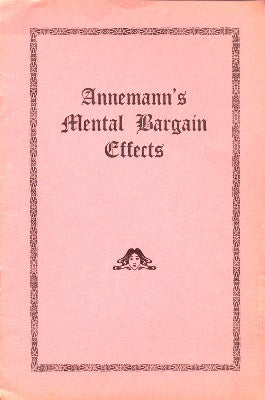
A compact 1935 collection of eleven mentalism effects, bringing together Annemann, Hewitt, Greta Annemann and J. G. Thompson: written thoughts, card revelations and apparent telepathy.
Eleven effects in a compact collection
Annemann’s Mental Bargain Effects first appeared in 1935. The familiar 16-page booklet brings together eleven items associated with Theodore “Ted” Annemann and fellow contributors. It is a collection of individual effects, rather than a prescribed complete act. Its small size makes it easy to survey, but should not be confused with a promise that every item is immediately ready to perform.
The material centres on the theatrical appearance of knowing information that should be inaccessible. Written thoughts, playing cards and messages provide different ways of presenting that premise. This gives readers several starting points for choosing material suited to their own performance character.
What is inside
The contents include Diabolo Pellet Reading, The Modern Mindreader, Psychic Writing, Mental Masterpiece and The New Double Telepathy Routine. Further contributions include Greta Annemann’s Eyes of the Unknown, 30th Century Television, Coincidence, Penetrating Vision, The Impromptu Mind Reader and GETIT! Credits include Hewitt and J. G. Thompson alongside Annemann; the booklet should not be described as eleven inventions by one author.
Mental Masterpiece is a card-centred demonstration built around a spectator’s thought-of card. Elsewhere, the collection explores written information and apparent agreement or transmission between minds. These are descriptions of the audience’s experience, not claims of supernatural ability. Readers looking for a broad course in mentalism should regard this as a focused source of routines rather than a comprehensive textbook.
Studying and adapting the material
A useful approach is to select one item and first write down what the audience is supposed to remember. Then examine the handling, instructions and sequence of revelations. A short explanation on the page can still demand careful rehearsal, especially when written information or several participants are involved.
For a modern presentation, keep the premise clear and use language that sounds natural to the performer. Test the routine in the intended setting before adding it to a paid programme. Visibility, pacing and the management of props matter as much as understanding the explanation. These are practical study recommendations, rather than a claim that the booklet provides a complete modern performance script.
Editions and buying a copy
Lybrary identifies the first edition as 1935 and its PDF as 16 pages. Printed reprints also commonly carry a 16-page description, while Trickshop lists a 14-page digital edition. Pagination alone therefore cannot establish the age or completeness of an unfamiliar copy. Check its publisher, title page, contents and format.
For a used booklet, ask for photographs of the actual copy, including the spine fold and staples. Look for loose leaves, annotations and moisture marks. A modern reprint can be a sensible reading copy; it should be identified clearly rather than offered as an original. The cover shown here illustrates one edition, not every printing.
Sources
[Lybrary – edition and contents](https://www.lybrary.com/annemanns-mental-bargain-effects-p-97.html) · [Magic Inc. – printed edition](https://www.magicinc.net/collections/hard-to-find/products/annemanns-mental-bargain-effects) · [Trickshop – digital edition](https://trickshop.com/mental-bargain-effects.html)