202 Methods of Forcing
Theo Annemann · 1933
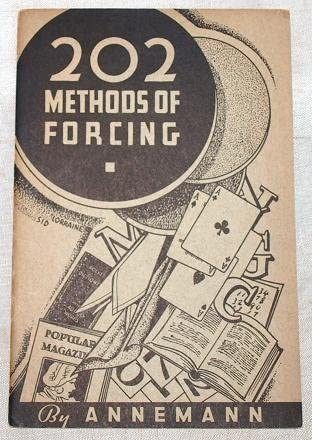
Theodore Annemann’s 1933 reference catalogues forces for cards, numbers, books and objects, ranging from impromptu handling to prepared decks and apparatus.
A reference book built around one essential principle
202 Methods of Forcing was published by Max Holden in New York in 1933. Theodore Annemann expanded his earlier 101 Methods of Forcing into a compact 35-page reference for magicians and mentalists. A force creates the appearance of a free decision while guiding a spectator toward a known or controlled outcome. The book is therefore a toolbox rather than a sequence of complete tricks.
The title needs clarification. The numbered entries run to 194, while several deck-changing procedures are counted separately to reach 202. Annemann acknowledged how difficult the methods were to classify. Jean Hugard helped locate about twenty-five later additions.
How the material is organised
The first large section covers ordinary playing cards: the Classic Force, counting and spelling procedures, top and bottom forces, knife and pocket selections, riffle approaches, cross-cut handling, dice, hats, envelopes and card boxes. Sleight-based solutions use palms, passes and false deals. Some methods are dependable controls; others rely on probability and require judgement plus a convincing alternative.
Prepared-card methods include Svengali, Menetekel, long-and-short, short-card, glued, reversed, rough-and-smooth and marked decks. A shorter group explains deck switches using clothing, pockets, tables, a chair servante, trays, cases or mirror glass. The number section includes 1089, calendars, addition forces, dice, business cards, watches, numbered cards, slates and books. The final portion expands the principle to coins, colours, envelopes, pages, words, newspaper advertisements, balls, handkerchiefs and other apparatus.
How to use the book effectively
Not every entry is equally strong or suitable for modern audiences. Compare preparation, certainty, angles, reset, spectator count, working conditions and the consequences of failure. A psychological or chance-based force needs an out. A mechanical method may be certain but less examinable. Sleight of hand permits ordinary objects but demands rehearsal and natural timing.
The book is most valuable to creators who know the effect they want and need several routes to the same controlled choice. It also documents how broadly Annemann understood forcing: not merely selecting a card, but controlling numbers, pages, words, people, colours and objects.
Historical limitations and collector notes
Treat the collection as historical technical literature, not as proof that every method remains deceptive exactly as printed. Language, props and staging often need updating. The 1933 Max Holden edition is generally described as a 35-page saddle-stitched booklet. Earlier copies of 101 Methods of Forcing are separate publications; later paperbacks, facsimiles, translations and digital editions vary in pagination and quality.
For an older copy, verify publisher, date, title page, completeness, staples, spine fold, annotations and loose leaves. Its lasting value lies in the comparative map it provides and in the habit it encourages: choose the method that fits the conditions instead of forcing every routine into one familiar technique.